Over 90% of U.S. employers rely on hiring algorithms to screen job applicants. Many different employers use algorithms from the same few vendors. We conduct the largest empirical study of algorithmic hiring with data for 3.4 million real job applicants submitting 4 million applications to 156 employers across 11 market sectors. Every application was assessed by algorithms from a single vendor: we test whether this algorithmic monoculture bottlenecks job opportunities. We are the first to demonstrate large-scale evidence of racial disparities and homogeneous outcomes in high-stakes hiring decisions.
Key Findings
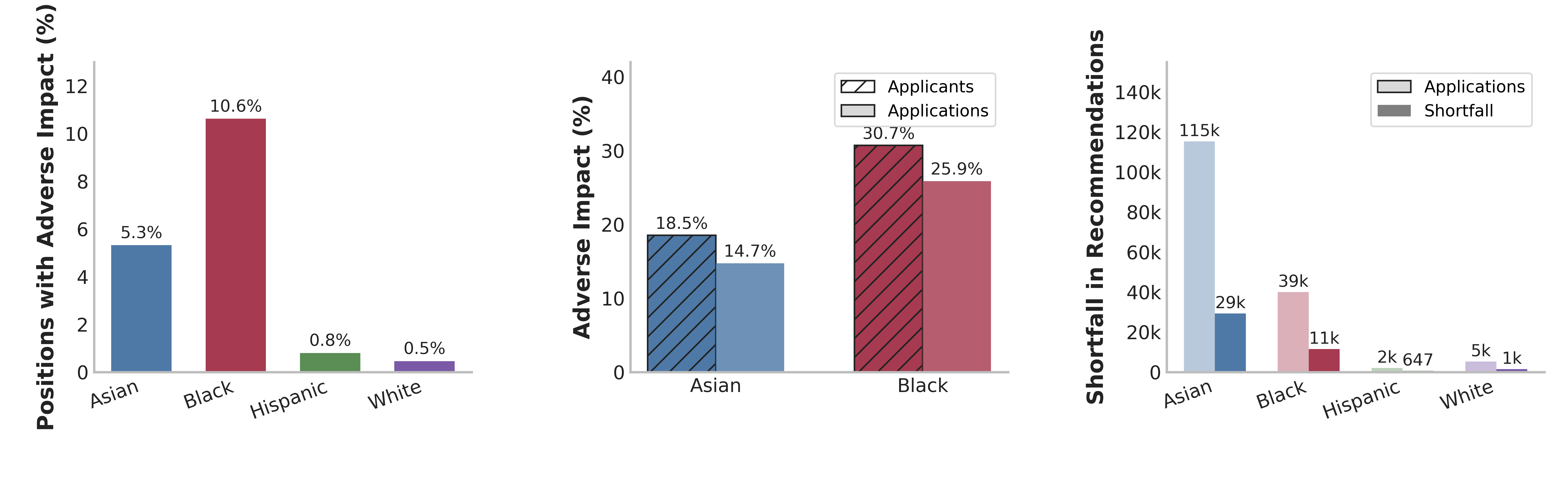
1Large-scale adverse impact for Asians and Blacks. We are the first to demonstrate adverse impact in deployed algorithmic hiring as one of the largest demonstrations of unfair outcomes in real high-stakes AI decisions. 25.87% of applications submitted by Black applicants and 14.74% of applications submitted by Asian applicants are directed to positions that adversely impact them based on the standards of the relevant U.S. employment law (Title VII).
2Adverse impact only revealed by disaggregated position-by-position analysis. While empirical studies of algorithmic hiring are very constrained due to data access limitations, prior studies showed minimal adverse impact due studying all of the vendor's data as a whole. By studying each position separately, in accordance with the standards of Title VII, we identify positions that demonstrate adverse impact that gets washed out in aggregate.
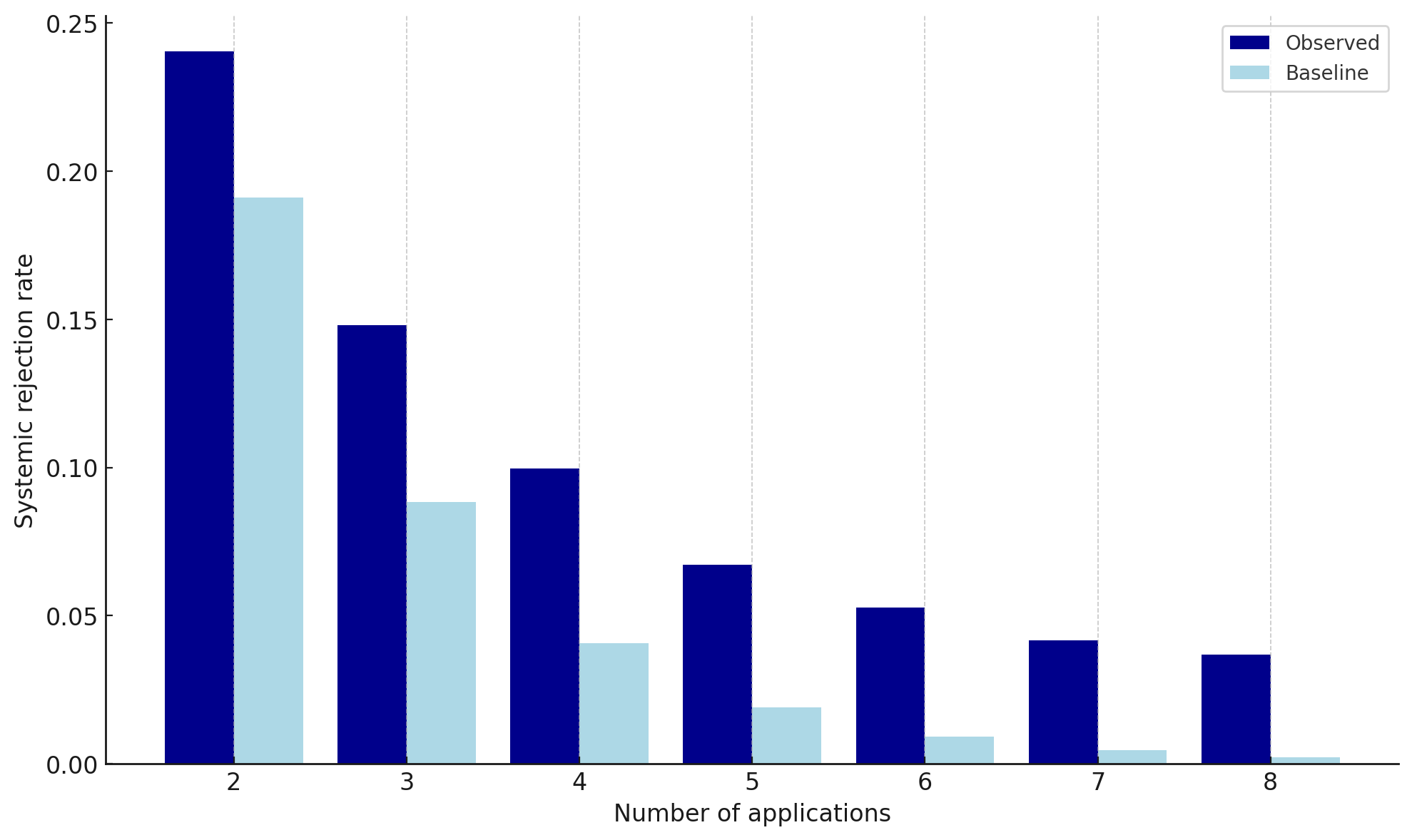
3Algorithmic monocultures in hiring yield systemic rejections. We are the first to demonstrate systemic rejections in deployed algorithmic hiring as posited in priortheoreticalresearch about algorithmic monoculture. The observed systemic rejection rate significantly exceeds that of the baseline of statistically independent decisions, even though the baseline accurately predicted observed systemic rejection rates in other hiring data in the absence of centralized algorithmic monocultures.
4Data access inhibits independent research into hiring algorithms. We are the first and only group to independently conduct empirical research deployed hiring algorithms at scale, even though hiring algorithms mediate high-stakes decisions and are pervasively adopted. Given the data barriers, policy intervention may be necessary to enable scientific inquiry and increase accountability into this high-impact application of AI.
Algorithmic Hiring Pipeline
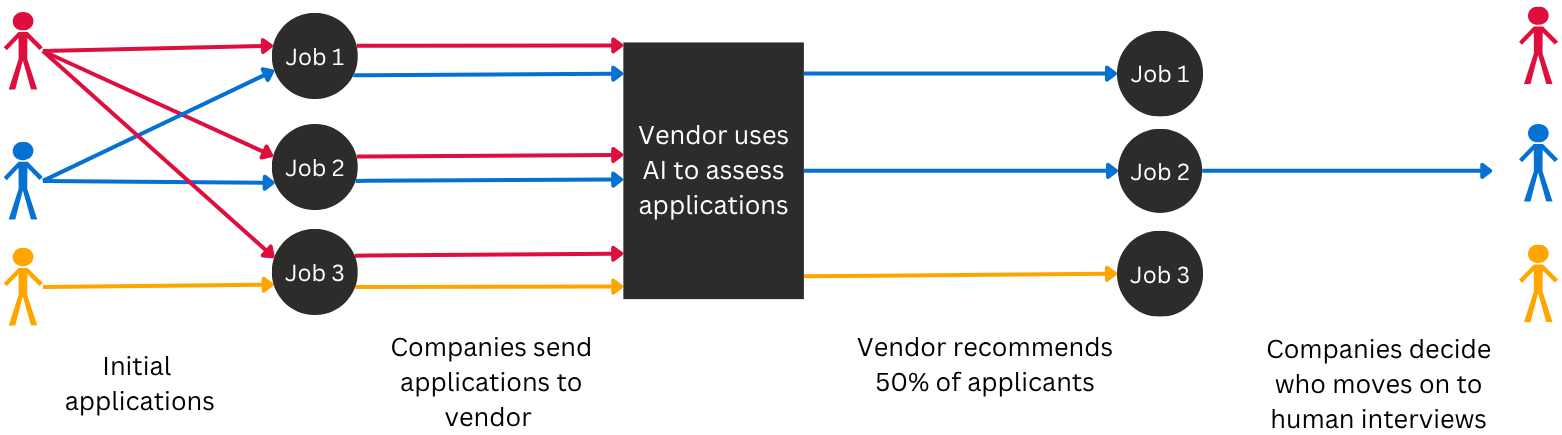
Many employers procure hiring algorithms from the same third-party vendors. Over 60% of the Fortune 100 use HireVue's algorithms. When hiring algorithms from a single vendor mediate hiring decisions at multiple employers, they constitute an algorithmic monoculture.
Figure 1. Job applications are assessed by hiring AI to be recommended or not recommended. If an applicant is not recommended by the algorithm, they are likely to be rejected without further consideration by a human.
Revealing Adverse Impact
Title VII of the US Civil Rights Act governs discrimination in hiring. Priorstudies found very limited adverse impact in algorithmic hiring data as a whole. We surface previously-overlooked adverse impact by studying positions separately. Black applicants are the most likely to be adversely impacted: 30% of Black applicants apply to at least one position that demonstrates adverse impact against Black applicants. In terms of total effect, Asian applicants experience the largest shortfall: if Asians were selected at the same rate as the most selected racial group for each position, then 29000 additional Asian applications would be recommended.
Figure 2. Adverse impact according to the Title VII four-fifths rule measured at the level of positions (left) and applications/applicants (center). The shortfall (right) is the number of applications that would have been selected if the adversely impacted racial group was selected at the same rate as the most selected group.
Identifying Systemic Rejection
When applicants apply to multiple positions, they can receive the same outcomes. Algorithmic monoculture could make this most likely. If so, the systemic rejections where applicants are rejected everywhere would be especially concerning. Of applicants that submit 4 applications, 10% are systemically rejected. The observed systemic rejection rate significantly exceeds the baseline rate expected under independent decisions (χ2 = 18,481, p < 0.001).
Figure 3. Systemic rejection rates in hiring AI data. The observed rates always exceed the baseline: shared dependence on one vendor yields homogeneous outcomes.
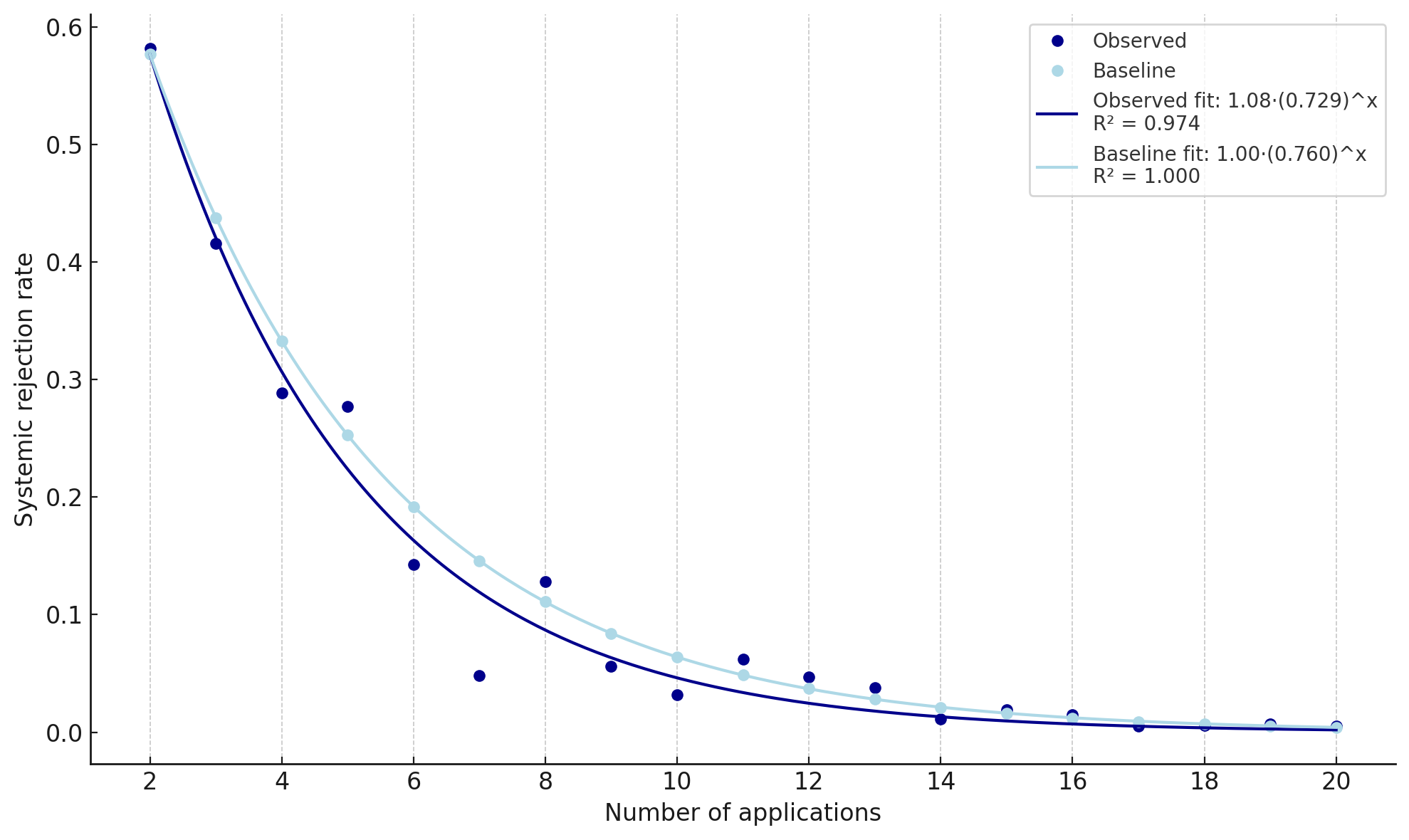
To contextualize the observed systemic rejection rates, we introduce the baseline of independent decisions (Toups et al., 2023). To test the predictivity of this baseline, we use data from the largest prior study of hiring (Kline et al., 2022), which sent 83,000 applications to 108 Fortune 500 firms. The baseline accurately predicts the observed rates (χ2 = 20.05, p = 0.69). Therefore, excess homogeneity is distinctive of centralized algorithmic assessment.
Figure 4. Systemic rejection rates for data from Kline et al. (2022). Unlike the algorithmic hiring data, the baseline accurately predicted the observed rates.
Simulating Counterfactual Outcomes
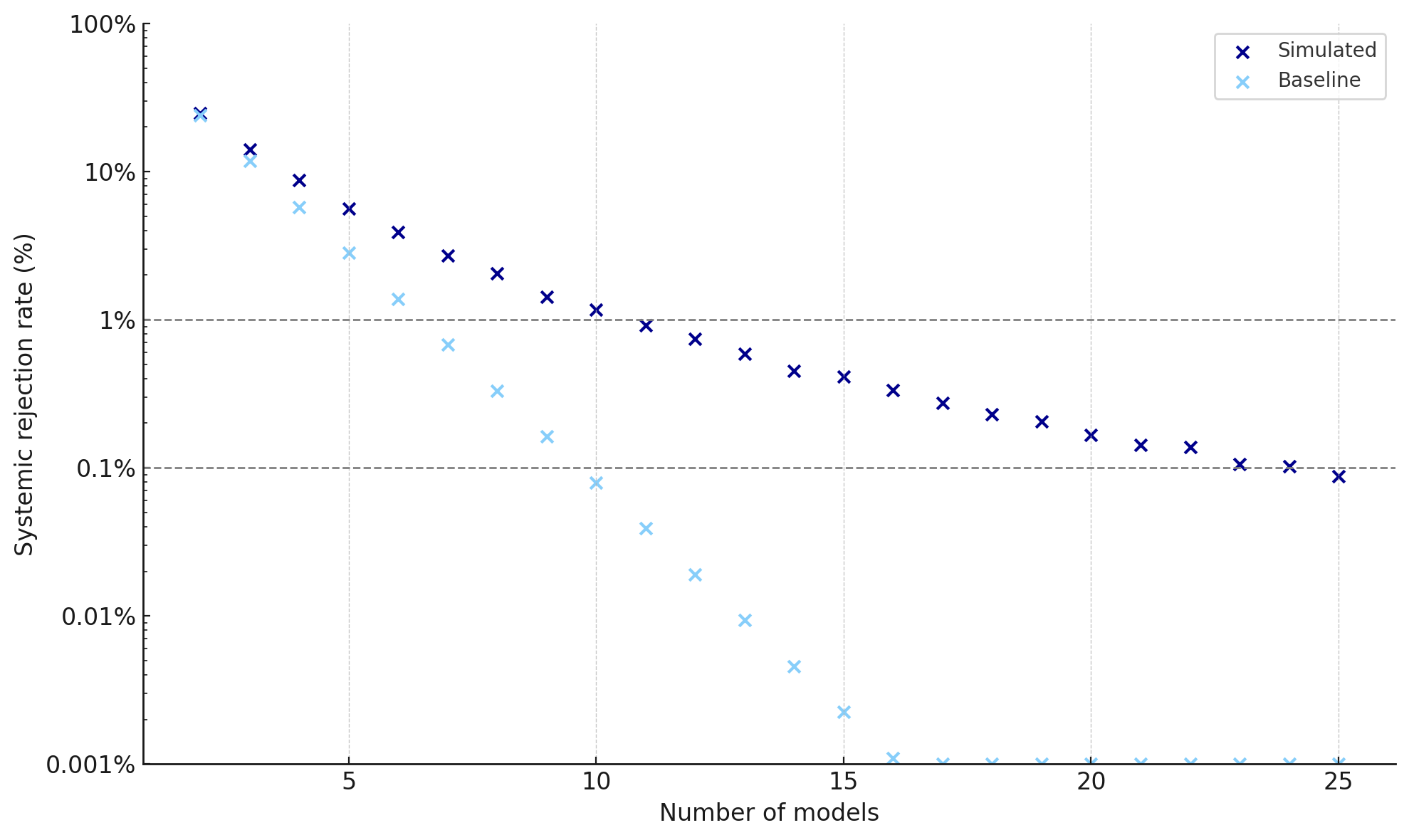
What would happen if applicants applied more broadly than they did in reality? Would this lessen their chances of systemc rejection? When applicants apply everywhere, we find that at least one model recommends them. But under more realistic behavior, applicants need to submit 25 applications to ensure at least one recommendation with 99.9% probability — compared to just 10 applications for independent decisions.
Figure 5. Simulated systemic rejection rates if applicants applied where they applied in reality, as well as to neighboring models that share applicants.
Policy Recommendations
Hiring AI is governed by employment discrimination law, general AI regulation, and specific rules for algorithmic hiring. In the U.S., Title VII already evaluates adverse impact at the level of specific jobs rather than blended aggregates. More broadly, hiring systems are increasingly treated as high-risk AI, including under the EU AI Act. At the municipal level, New York City Local Law 144 established an early framework for regulating automated employment decision tools, but current guidance does not adequately address the position-level effects we document.
1
Measure adverse impact per position. Regulators and auditors should evaluate adverse impact ratios at the level of individual positions. Aggregate-only analyses can conceal disparate impact.
2
Strengthen market surveillance. Federal agencies should quantify the rate of homogeneous outcomes. Without cross-employer links, existing reporting won't capture systemic rejection.
3
Monitor algorithmic monoculture. Policymakers should surveil shared dependencies in the hiring supply chain. Concentrated reliance on the same systems can yield correlated failures, systemic rejection, and reduced competition in hiring.
4
Expand researcher access. Legislators should stimulate independent research, including underlying data access, into major hiring platforms. Issues will be difficult to diagnose, let alone rectify, without the foundation of empirically-grounded externally-conducted inquiry.
Citation
@article{bommasani2026algorithmic,
title={Algorithmic Monocultures in Hiring},
author={Bommasani, Rishi and Bana, Sarah H. and Creel, Kathleen A. and Jurafsky, Dan and Liang, Percy},
booktitle={Proceedings of the 2026 ACM Conference on Fairness, Accountability, and Transparency},
year={2026}
}